
Blog on RFID Technology and IoT Solutions

Blog Home
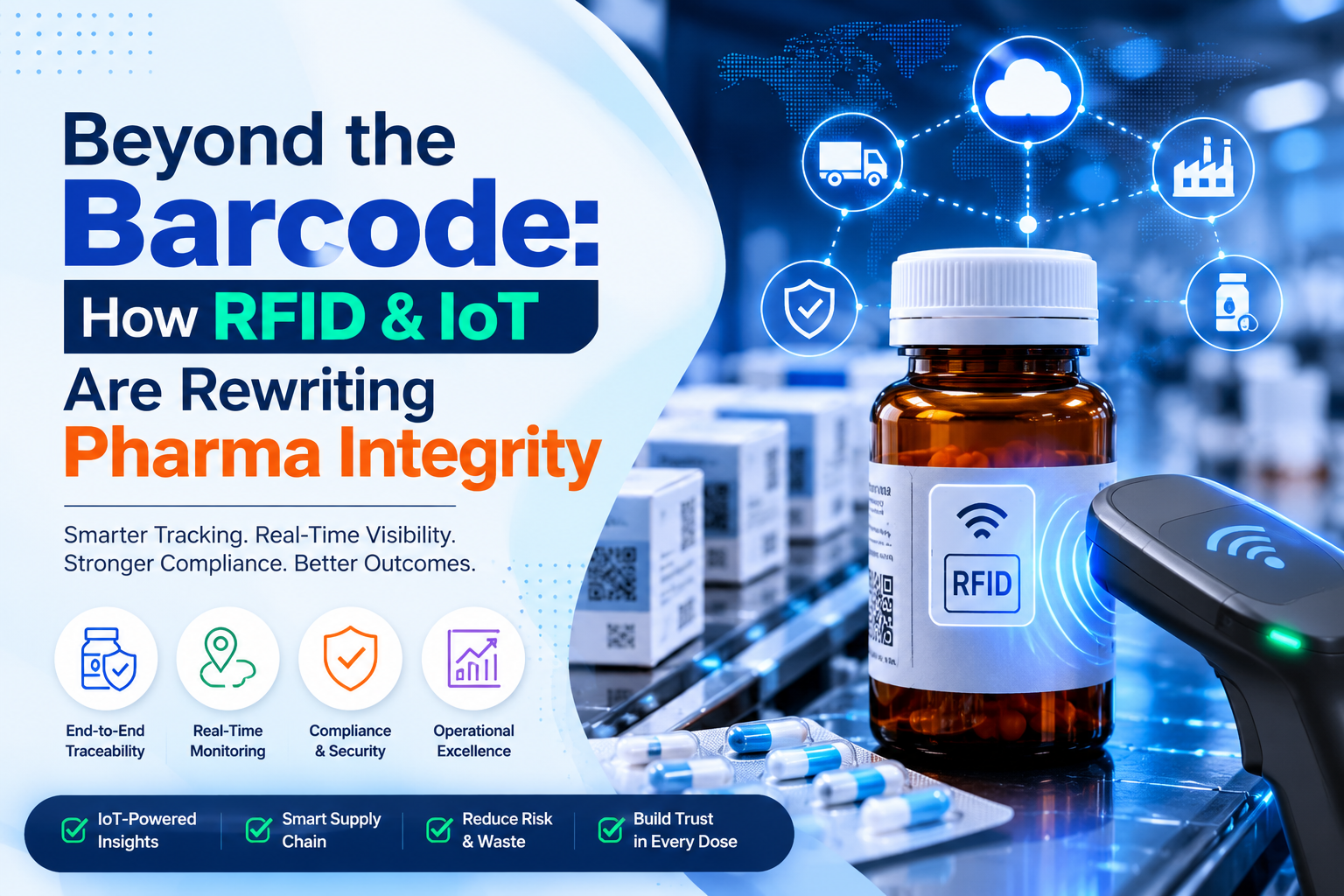
Beyond the Barcode: How RFID & IoT Are Rewriting Pharma Integrity

Beyond the Barcode: How RFID & IoT Are Rewriting Pharma Integrity

13 July 2026

One missing pallet can cost more than money — it can cost patient safety. Here’s why the industry is racing past legacy tracking, and what a smarter supply chain actually looks like.

The Cost of a Missing Pallet

Picture this: a pallet of temperature-sensitive oncology drugs leaves the distribution centre. Somewhere between the loading dock and the hospital, it vanishes — not physically, but from the digital record. Nobody scanned it at the right checkpoint. The barcode trail goes cold.

What follows isn’t just a paperwork headache. It’s incomplete regulatory documentation, an emergency replacement order, and a scramble that eats into margins and trust. The real risk was never just financial. It was patient safety, sitting quietly in a gap that a barcode was never built to close.

Barcodes tell you where a product was. Patients need to know where it is — right now.

Why Barcodes Can’t Keep Up Anymore

Barcodes served the industry well for decades. But in a world of serialized compliance, cold chain mandates, and thousand-unit daily volumes, they’ve become the weakest link in an otherwise digital chain.

No Line-of-Sight Needed

RFID reads multiple items at once, automatically — no operator scanning each unit by hand.

Continuous, Not Point-in-Time

Instead of a single scan snapshot, RFID builds a live tracking ecosystem across every checkpoint.

Built for Volume

Thousands of serialized products a day, automated — faster counting, faster reconciliation.

Senses the Environment

Merge tracking with temperature and humidity sensors to protect cold chain integrity end to end.

Beyond Track-and-Trace: A Unified IoT Ecosystem

IntelliStride doesn’t stop at tagging a drug package. We build the connective layer between hardware, data, and the systems your teams already rely on — turning scattered checkpoints into one living view of your supply chain and your facility.

  • CT The CrossTalk IoT Platform

    A dedicated software layer that connects RFID readers and antennas directly with your ERP and WMS — no rip-and-replace required.

  • HA Hospital Asset Management

    From medical devices to patient records, beds, and wheelchairs — tracked with passive and active RFID or Wi-Fi.

  • CW Smarter Clinical Workflows

    Optimized lab and operating theatre utilization means high-value equipment is ready exactly when it’s needed.

  • SU Specialized Use Cases

    Smart incontinence monitoring, lab specimen tracking — purpose-built solutions that automate data entry and replace manual logs.

Compliance Isn’t Optional — It’s Competitive Advantage

Global mandates like the Drug Supply Chain Security Act (DSCSA) and the Falsified Medicines Directive (FMD) have moved from “nice to have” to non-negotiable. The companies pulling ahead are the ones treating compliance as infrastructure, not paperwork.

  • 100% Audit-ready digital logs
  • ±0.5°C Pharma-grade sensor accuracy
  • Unique ID Per RFID tag, anti-counterfeit

Every RFID tag carries a unique digital identity, making it nearly impossible for counterfeit drugs to slip into official distribution channels. And because reliability depends on hardware as much as software, precision-built readers and embedded controllers keep signals accurate even in refrigerated trucks or dense, high-interference warehouses.

Every Pharma Fleet Has Unique Needs

Whether it’s selecting the right tag for liquid-filled containers or integrating with a specific ERP, the right path is a phased rollout backed by expert guidance — not a one-size-fits-all box.

Ask IntelliStride About RFID & IoT for Pharma

Tap a question below to see how we answer it — or type your own and our team will follow up directly.

Can RFID tags be used on liquid-filled pharmaceutical containers?

Yes — but it takes careful engineering. Liquids absorb RF signals, which can shrink detection range, so tag selection matters more than usual with liquid-filled products.
  • Correct tag type is critical — the wrong one means poor read accuracy
  • Pilot testing validates performance before full rollout
  • Hardware (tags, readers, embedded systems) is matched to your packaging format

How does IntelliStride solve the signal absorption issue with liquids?

Through tailored tag selection, precision hardware engineering, and structured validation. We start with a Proof of Concept, place readers and antennas at key points like loading doors and production lines, then validate with a pilot program before scaling — with CrossTalk managing the data flow throughout.

How do environmental sensors help maintain cold chain integrity?

Sensors give continuous, real-time visibility instead of one-off spot checks.

  • Live temperature, humidity, and location data streamed to the cloud
  • Instant SMS and dashboard alerts if thresholds (e.g. 2–8°C for vaccines) are breached
  • Timestamped, tamper-evident logs for DSCSA and GDP audits

What’s the difference between passive and active RFID tags?

Passive tags have no internal power source — they’re activated by the reader’s signal, making them low-cost and ideal for high-volume item-level tracking. Active tags carry their own battery and broadcast continuously, giving longer range and real-time location — better suited for high-value assets like hospital beds or equipment that need constant monitoring.

How does the CrossTalk platform integrate with our existing ERP?

CrossTalk sits between your hardware (RFID readers, antennas, sensors) and your existing ERP or WMS, pushing data via APIs so both systems share a single source of truth — no manual re-entry, no rip-and-replace of what you already run.

How does RFID improve hospital asset and OT utilization?

By tracking equipment location and readiness in real time, staff know instantly what’s sterilized, located, and available — cutting idle time between procedures. The same visibility extends to beds, wheelchairs, and devices, reducing losses and letting hospitals safely run leaner inventory.

What is smart incontinence monitoring, and how does it work?

Sensors built into smart diapers detect wetness levels and send instant alerts to caregivers’ phones or nurse-call systems the moment a change is needed. Beyond convenience, the trend data can flag early signs of dehydration or UTIs, while digital records replace manual logs entirely.
 

    Subscribe To Our Newsletter

    Join our mailing list to get our latest updates

    IntelliStride

    Download