
Blog on RFID Technology and IoT Solutions
Blog Home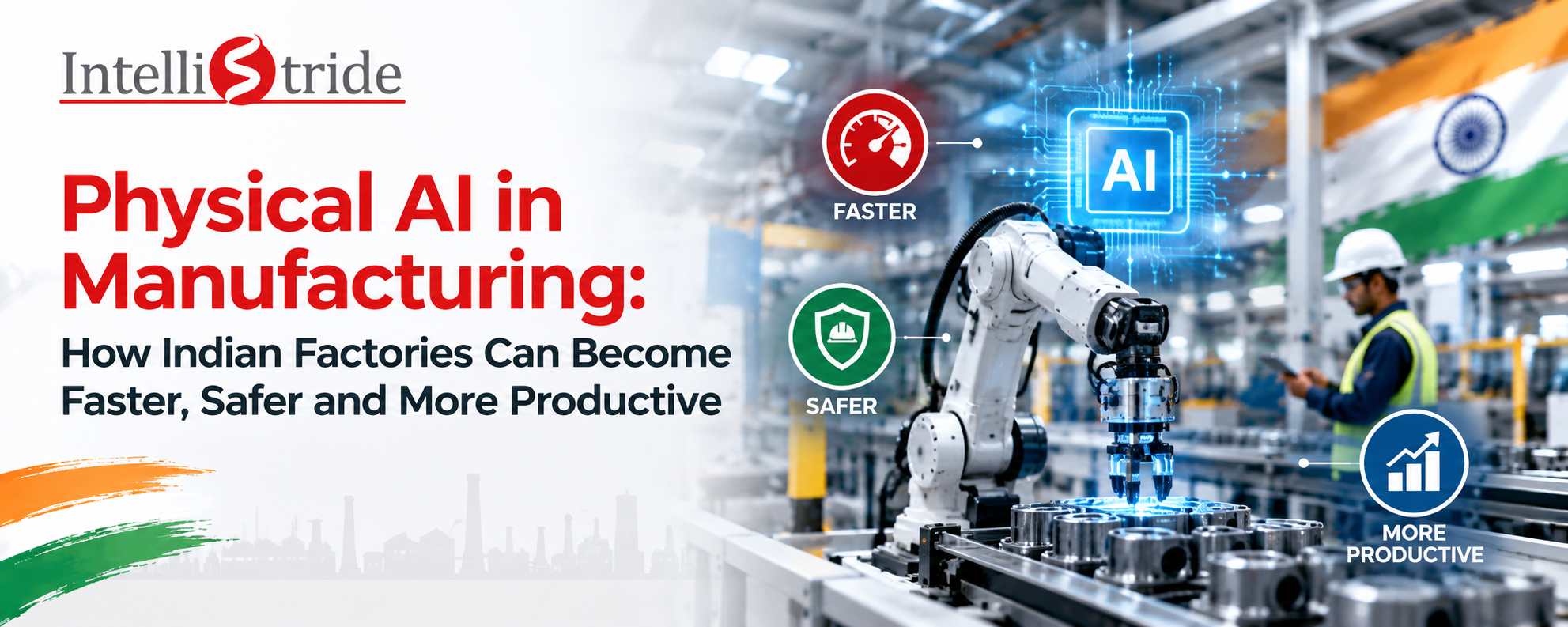
Physical AI in Manufacturing: How Indian Factories Can Become Faster, Safer and More Productive
14 October 2026Most of us know AI as something that lives on a screen. A plant manager in Pune or a warehouse head in Gurugram needs to know where a critical tool is, why a line stopped, and how to prevent the next breakdown.
That is the promise of Physical AI: intelligence that leaves the screen and works on the factory floor.
What Is Physical AI?
Physical AI is artificial intelligence that senses, understands and acts in the physical world. It connects AI with machines, vehicles, warehouses, infrastructure and people through sensors, RFID, real-time location systems (RTLS), computer vision, robotics, edge computing, 5G and digital twins.
Traditional automation follows pre-programmed instructions. If conditions change, it fails or stops. Physical AI follows a Perceive, Reason, Act loop:
- Perceive: sensors, tags and cameras capture what is happening in real time.
- Reason: AI models interpret the data against a live digital model of the facility.
- Act: the system triggers an alert, reroutes a robot, adjusts a machine or dispatches a person.
Analysts project the Physical AI market to reach roughly €430 billion by 2030, and manufacturing is its biggest proving ground.
How Physical AI Works: Sense, Understand, Act
Sense
RFID, BLE, RTLS, vision systems and custom sensors on assets, inventory, vehicles and people. AI is only as good as the data it sees.
Understand
A platform and digital twin turn raw signals into a live map of where everything is and what is happening. Edge computing keeps decisions fast.
Act and govern
Workflows, robots, cobots and AMRs execute, with humans supervising exceptions and edge cases.
You do not need to rip out existing infrastructure. You connect what you have and add intelligence where it pays back.
Key Benefits of Physical AI
Higher productivity
Less searching, waiting and manual tracking, and more throughput from the same assets.
Predictive maintenance
Spot the early signs of failure before a line stops.
Zero-defect quality
Vision and sensors catch defects during production, not after.
Safer workplaces
Machines take over hazardous, repetitive and ergonomically heavy tasks.
Lower energy use
Real-time monitoring reveals waste in power, material and movement.
Faster decisions
One live source of truth replaces spreadsheets, paper logs and phone calls.
Physical AI Use Cases Across Sectors
Manufacturing
Real-time tracking of tools, trolleys, moulds and work-in-progress. Vision-based inspection. Predictive maintenance. AMRs for line-side material flow.
Semiconductor and electronics
Fast-cycle environments with strict compliance. RFID smart cabinets, connected carts, tool and spares tracking, and digital twins improve uptime and traceability.
Warehousing and logistics
Live inventory visibility, RFID tunnels for dock-door accuracy, container and vehicle tracking, smart returnable transport items.
Pharmaceuticals
Batch traceability, cold-chain monitoring, anti-counterfeit tracking and audit-ready records.
Automotive
Part-level traceability, sequence-accurate delivery to assembly lines, yard tracking and quality control at speed.
Infrastructure and transport
Toll automation, fleet tracking and asset health monitoring. Assets can signal when they need attention rather than waiting to fail.
Energy and utilities
Remote asset condition monitoring, worker location and safety in hazardous zones, faster field response.
Retail and consumer goods
Item-level inventory accuracy, smart shelves and faster replenishment.
How Physical AI Impacts ROI
Robotics and automation projects once had a reputation for long payback periods and heavy integration costs. Industry research from firms such as BCG, McKinsey and PwC points to a shift:
| ROI driver | Legacy automation | Physical AI |
|---|---|---|
| Payback period | 5 to 7 years | 1 to 3 years |
| Integration share of budget | ~75% | Cut by more than half |
| Collaborative robot entry cost | $100,000 to $500,000 (traditional industrial robots) | $20,000 to $35,000 (edge-AI cobots) |
| Engineering time to train and deploy | Baseline | ~21% lower |
| Logistics efficiency with AMRs | Baseline | ~25% better, ~10% better routing |
Why does the economics change?
- Software-defined flexibility: a system can be retrained rather than rebuilt.
- Simulation first: digital twins let you train and test virtually, so there is little or no plant downtime during rollout.
- Start small, scale fast: a pilot on one line or one asset class can prove value in weeks, and the same platform extends to the next site.
- Hidden costs become visible: idle assets, search time, unplanned stoppages and quality escapes finally show up as numbers you can reduce.
Physical AI also changes how work is done. Floor teams move from doers to supervisors and experts. Instead of chasing missing material, they manage exceptions, analyse performance and improve the process. Research suggests around half of repetitive, hazardous or ergonomically demanding subtasks can be automated, while people move into higher-value roles.
Why Physical AI Matters for Indian Factories and Industries
India averages roughly 7 industrial robots per 10,000 manufacturing workers, against around 470 in China. That gap looks like a weakness. It is also a chance to leapfrog.
- No legacy lock-in: many Indian plants can skip rigid, hard-coded automation and go straight to flexible, software-driven systems.
- Brownfield-friendly: India runs on millions of existing assets, machines, vehicles and warehouses. Physical AI makes them progressively intelligent without replacing them.
- Speed to value: low entry costs and fast deployment suit mid-sized manufacturers, not just large conglomerates.
- Workforce advantage: India’s large, skilled workforce is an asset. Physical AI augments it with safer jobs and faster upskilling.
- Competitiveness: with PLI schemes, China+1 sourcing and the push for semiconductor and electronics manufacturing, faster cycle times and traceability can decide who wins global orders.
How to Get Started with Physical AI
- Pick one painful problem, such as asset search time, downtime, inspection errors or inventory mismatch.
- Assess readiness: what data, connectivity and systems (MES, ERP, WMS) you already have.
- Build the sensing layer first with RFID, RTLS, vision or custom sensors.
- Pilot and measure against a clear baseline: hours saved, downtime reduced, accuracy gained.
- Scale across lines and sites on a common platform, with managed oversight.
How IntelliStride Helps
IntelliStride is an IoT and asset intelligence company working across RFID, RTLS, vision, sensors and our IoT Platform, with an exclusive Kathrein hardware partnership and a presence across 16+ APAC markets. Our deployments include 4M+ RFID tags and 2,000+ read points, built on 150+ proven use cases.
We own the layers where Physical AI succeeds or fails: Sense (the right hardware), Understand (a live digital twin of your operations) and Govern (managed services and an IoT PMO to oversee execution and upskill your workforce). Robotics and AMR partners plug in through our ecosystem. You can buy it as IoT as a Service, delivered on-premise or remote.
Frequently Asked Questions About Physical AI
What is Physical AI in simple words?
Physical AI is AI that works in the real world. It uses sensors, cameras, RFID and robots to see what is happening, decide what to do and act on it, instead of only producing text or images on a screen.
How is Physical AI different from Industry 4.0 or normal automation?
Traditional automation repeats fixed instructions. Physical AI adapts to changing conditions in real time and learns from data and simulation.
Is Physical AI only for large companies?
No. Entry costs are falling, and you can start with one use case on one line. Mid-sized manufacturers often see value fastest because they have fewer legacy constraints.
How much does Physical AI cost in India?
It depends on scope. Edge-AI cobots start around $20,000 to $35,000, and many sensing and tracking projects start as small pilots. IoT-as-a-Service models reduce upfront capital.
What is the ROI of Physical AI and how soon can I see it?
Industry research suggests payback of 1 to 3 years, with pilots often showing measurable results within weeks or months through reduced search time, downtime and errors.
Will Physical AI replace workers?
The evidence points to augmentation. It takes over hazardous and repetitive tasks and moves people into supervision, analysis and exception handling, with upskilling as part of the programme.
Do I need to replace my existing machines and software?
No. Physical AI is designed to connect existing assets and integrate with your MES, ERP and WMS. You add intelligence layer by layer.
Which industries benefit most?
Manufacturing, semiconductor and electronics, pharma, automotive, logistics, retail, energy and infrastructure. Any operation with high-value assets and physical movement can benefit.
What technologies are involved?
RFID, RTLS, BLE, computer vision, IoT sensors, edge computing, 5G, digital twins, AMRs and cobots, tied together by an IoT platform.
Is Physical AI safe and secure?
Yes, when designed properly. Safety standards, role-based access, edge processing and human oversight of exceptions should be built in from day one.
How do I start?
Begin with a readiness assessment and a focused pilot. IntelliStride can help you pick the use case, design the architecture and measure the payback.
Ready to Make Your Factory Physical-AI Ready?
Whether you run a plant, a warehouse or a supply chain, the first step is the same: know what is happening in your physical operations, in real time.
- Intellistride.com
- Blog
- Physical AI in Manufacturing: How Indian Factories Can Become Faster,…