
Blog on RFID Technology and IoT Solutions
Blog Home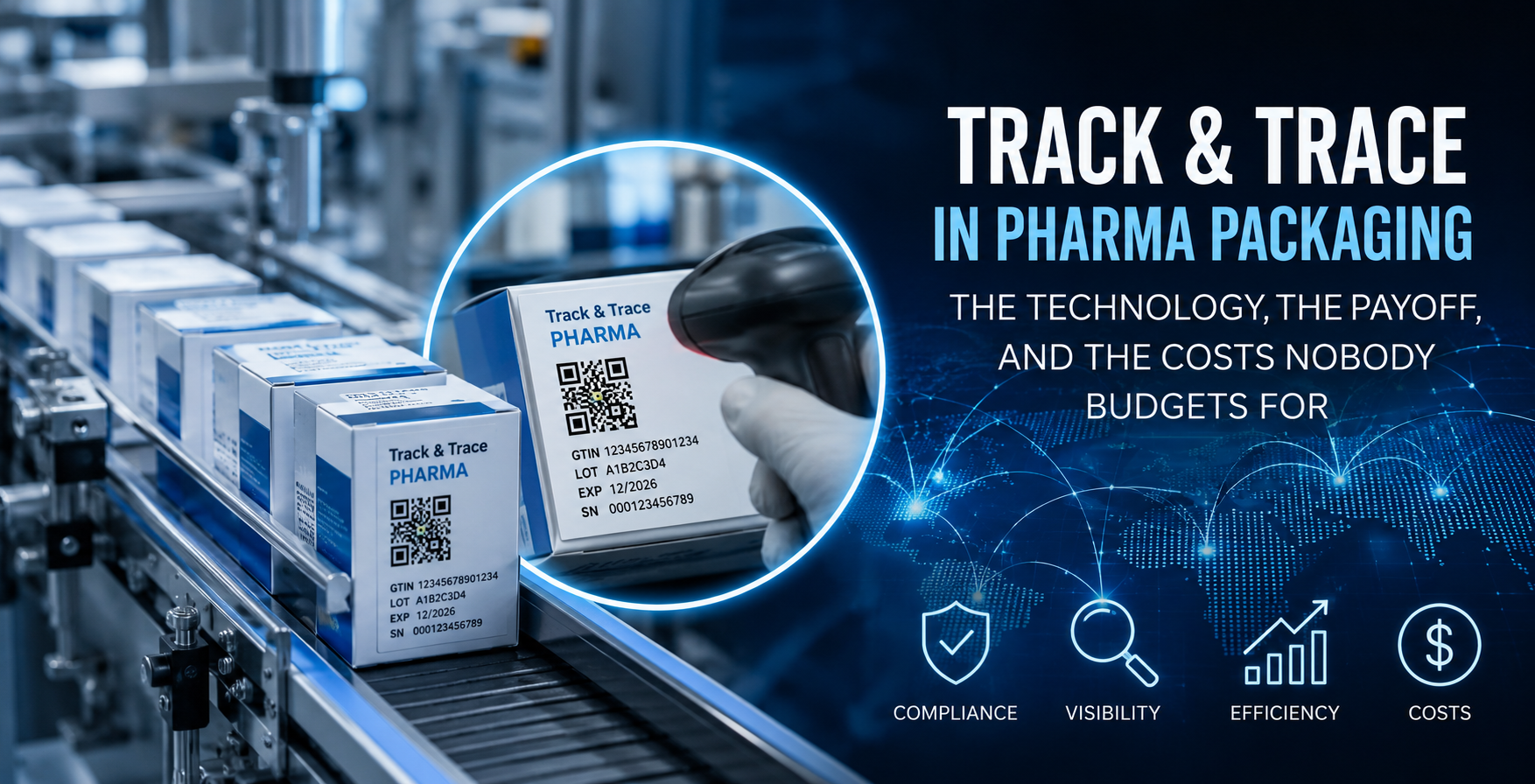
Track & Trace in Pharma Packaging: the Technology, the Payoff, and the Costs Nobody Budgets For
14 August 2026RFID and IoT have moved track & trace far past barcodes. Here’s what’s actually running on packaging lines today, the problems it solves, and the hidden costs below the waterline of every RFID business case.
Every second, somewhere in the world, a patient is handed a medicine that has passed through a dozen invisible hand-offs before it reached them — a raw-material store, a packaging line, an inspection point, a warehouse, a distributor, a pharmacy shelf. For most of pharma’s history, that journey was tracked on paper, barcodes and trust. Today it can’t be. Counterfeit and diverted medicines injure and kill patients every year, regulators from India to the EU to the US have tightened serialization law, and a single undetected batch problem can trigger a recall that costs far more than the packaging line that caused it. Track and trace has moved from “nice to have” to the cost of staying in business.
The technology behind it has changed fast enough that many manufacturers are still budgeting for yesterday’s version. Here’s what’s actually running on packaging lines now, what problems it solves, what it costs — and, more importantly, what it costs that nobody puts on the first slide of the business case.
The current generation
What track and trace looks like now
Barcodes and manual scanning built the first generation of pharma traceability, and they’re still part of the stack. But barcodes need line-of-sight, one item at a time, and a human holding the scanner. The current generation layers three things on top: RFID for bulk, non-line-of-sight identification; IoT sensors on the packaging line itself, capturing speed, condition and status in real time; and a cloud analytics layer — platforms like IntelliStride’s CrossTalk — that turns thousands of individual read events into a single, searchable record of where every unit, carton and pallet has been.
In practice, this runs across five points on the line. Every hand-off writes a timestamped, immutable event — nothing has to be re-keyed, and nothing has to be taken on faith.
On the packaging floor
The problems it actually solves
Strip away the acronyms and track and trace is solving five very concrete packaging-floor problems.
Counterfeiting & diversion
A unique serial number per unit, verified automatically at every hand-off, makes it possible to detect a tampered, diverted or counterfeit product before it reaches a patient — something a printed batch number never could.
Recall scope
Without unit-level data, a quality issue forces a broad, expensive withdrawal of an entire product line. With it, a manufacturer isolates the exact batches and serials affected and leaves the rest untouched.
Compliance load
Serialization mandates are expanding — India’s Schedule H2, the US DSCSA, the EU Falsified Medicines Directive — and each requires an auditable, GS1-compliant record. Automated capture is what makes that record scale.
Manual reconciliation
Barcode scanning, counting and paper reconciliation eat real labour hours on every shift. RFID’s non-line-of-sight, bulk-read capability removes most of that manual step entirely.
Supply-chain fragility
Recent years have shown how quickly logistics can break down. Manufacturers that once accepted periodic, end-of-day visibility are moving to real-time tracking because a two-day-old inventory picture is no longer good enough when a shipment is delayed or a route changes overnight.
Where it pays off
Where the benefit shows up
The immediate win is patient safety and audit-readiness — an immutable digital event history that satisfies ALCOA+ and 21 CFR Part 11 expectations without extra manual documentation. But the benefits compound downstream: line efficiency improves because non-line-of-sight RFID reads cut manual scanning, and regulatory reporting becomes a by-product of normal operations instead of a separate end-of-month exercise.
Increasingly, traceability is a commercial requirement, not just an internal one — global buyers and contract manufacturers are asking suppliers to prove it before they’ll sign at all.
The business case
What it actually costs — the iceberg underneath
Here’s where most business cases go wrong. The number everyone quotes — tag price times unit volume — is the smallest, easiest number in the whole decision, and the one most likely to get a project either rejected or approved on the wrong basis.
- Waterline — what gets budgeted
- Visible costs
- ReadersTagsSoftware license
Hidden below the waterline
- ERP / MES integration
- Tag placement testing & read-rate tuning
- Process redesign & SOP updates
- Operator training & change management
- Data reconciliation during rollout
- Ongoing maintenance & tag lifecycle
The costs below the waterline are usually larger than the visible ones combined. None of them show up in a per-tag quote. All of them show up in the first-year budget if nobody planned for them. The honest way to build the business case is a three-level ROI framework, not a single payback number.
1:- Direct savings
Less manual scanning, counting and reconciliation, and fewer recording errors. The easiest to quantify — and the one most companies stop at.
2:- Operational benefits
ERP/MES integration pays off as faster material movement, better inventory accuracy and higher line utilization — value that shows up once the system is fully embedded in daily operations.
3:- Strategic value
End-to-end traceability, faster investigations when something does go wrong, and stronger customer and regulator confidence in the business as a whole.
The takeaway
The bottom line
Track and trace isn’t a compliance checkbox anymore — it’s infrastructure, in the same category as a facility’s utilities or its quality system. The manufacturers getting real value from it aren’t the ones who bought the cheapest tag; they’re the ones who budgeted for the whole iceberg, built the business case on operational and strategic value rather than tag price alone, and treated the rollout as a change-management project as much as a technology one.
Questions pharma teams ask most
What is track and trace in pharma packaging?
Track and trace is the ability to identify and follow a pharmaceutical unit, carton or pallet through every stage of packaging and distribution, using technologies like barcodes, RFID and IoT sensors to create a verifiable, timestamped record of where the product has been.
Is RFID mandatory for pharma packaging?
RFID itself usually isn’t mandated by name, but serialization and traceability are — under India’s Schedule H2, the US DSCSA, and the EU Falsified Medicines Directive. RFID and IoT are the technologies manufacturers are adopting to meet those requirements efficiently at scale.
What’s the difference between barcode and RFID track and trace?
Barcodes require line-of-sight scanning of one item at a time by an operator. RFID reads tags in bulk, without line-of-sight, and can also capture condition data through IoT sensors — which is why it’s replacing barcode-only systems on high-volume packaging lines.
How much does RFID track and trace cost to implement?
The visible cost is tags, readers and software licensing. The real cost also includes ERP/MES integration, read-rate tuning, SOP redesign, operator training, data reconciliation during rollout, and ongoing tag lifecycle management — costs that are usually larger than the tag price itself if they aren’t planned for upfront.
How does track and trace prevent counterfeit medicines?
By giving every unit a unique, verifiable digital identity that’s checked automatically at each hand-off point, so a tampered, diverted or counterfeit product can be detected and stopped before it reaches a patient — rather than discovered after the fact.
What is the ROI of RFID in pharma packaging?
ROI shows up in three tiers: direct labour savings from reduced manual scanning and reconciliation, operational gains from better inventory accuracy and line utilization once the system is integrated, and strategic value from faster investigations, narrower recalls and stronger customer confidence.
Does track and trace slow down the packaging line?
Properly implemented, it speeds the line up. Non-line-of-sight RFID reads eliminate manual scanning and counting steps rather than adding to them — the slowdown sometimes blamed on “traceability” usually comes from poorly tuned read rates or unintegrated systems, not the technology itself.
- Intellistride.com
- Blog
- Track & Trace in Pharma Packaging: the Technology, the Payoff,…