
Blog on RFID Technology and IoT Solutions
Blog Home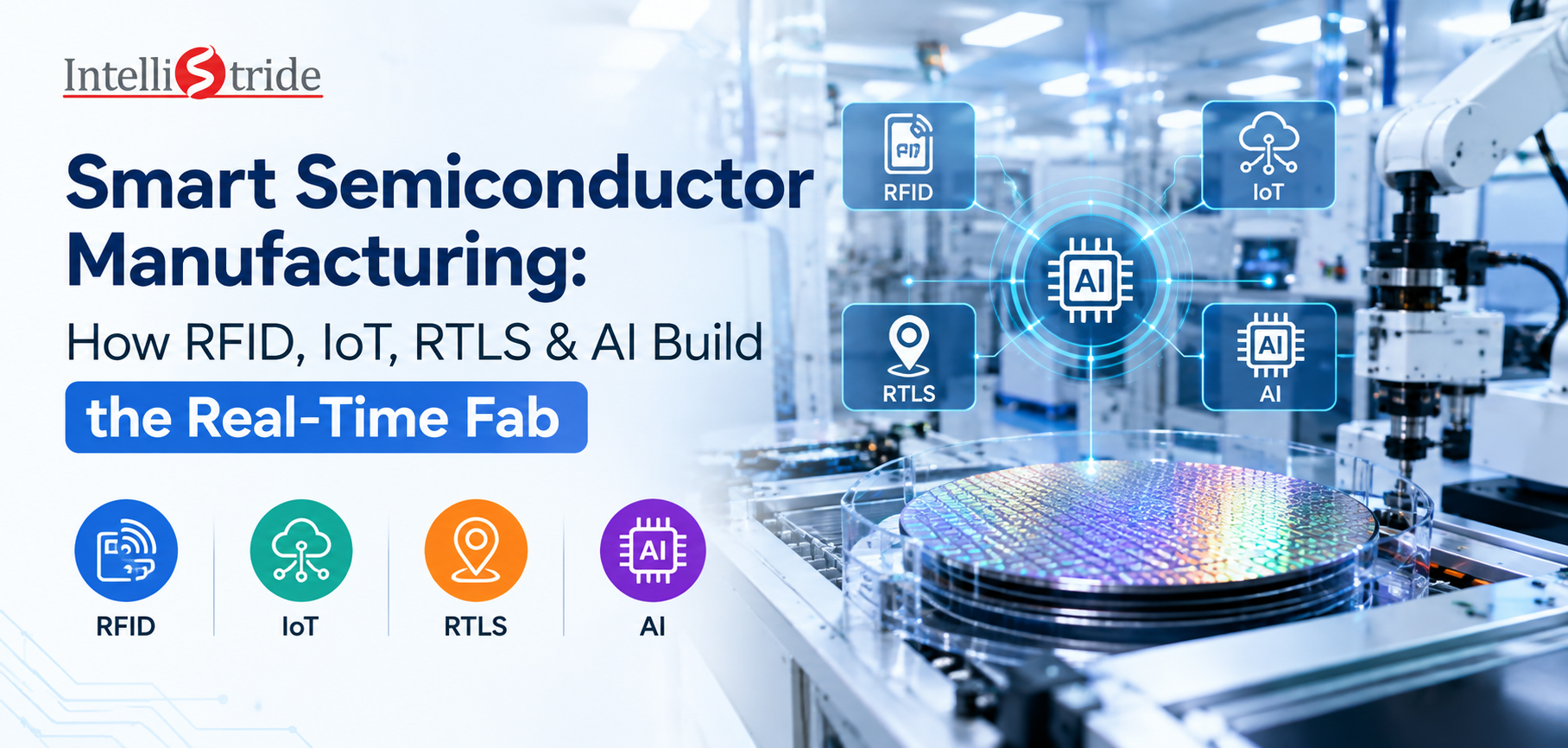
Semiconductor manufacturing runs on sub-micron tolerances, cleanroom-grade contamination control and thousands of process steps per wafer lot. Yet on many fab floors, the physical world is still tracked by manual scans, phone calls and spreadsheets. This guide explains how RFID, IoT sensing, Real-Time Location Systems (RTLS) and AI close that gap, and how to start without disrupting production.
Why Semiconductor Manufacturing Is Uniquely Hard
A single fab handles wafer carriers (FOUPs/FOSBs), reticles and specialty tools worth tens of thousands to several million dollars each. A missing spare at the wrong moment can stall an entire line. Several pressures compound the complexity:
- Compliance: strict adherence to quality and SEMI standards at every step.
- Supply chain risk: geopolitical disruption, labor constraints and demand-supply imbalance.
- Talent shortages: scarce process and equipment specialists.
- Manual tracking: bottlenecks in fast-cycle operations and weak end-to-end visibility.
- Downtime: unplanned stoppages are costly, and maintenance is still shifting from reactive to predictive.
- Spares and storage: high carrying costs sitting alongside shortages.
Almost all of these share one root cause: data fragmentation between IT and OT. ERP and MES hold the intended process. Nothing confirms what is physically true, so the fab manages production on faith rather than fact.

The Business Cost of Invisibility
Each visibility gap maps to a financial outcome and an executive KPI, which is the translation every technology proposal must survive in front of the CFO.
| Problem | Operational impact | Financial impact | KPI |
|---|---|---|---|
| Missing tools/equipment | Delays, search time | Lost capacity, overtime | OEE |
| Poor WIP visibility | Waiting, manual search | Longer cycle time | Throughput |
| Unplanned downtime | Production interruption | Direct revenue loss | Availability |
| Inventory inaccuracy | Excess stock or shortages | Working-capital impact | Inventory turns |
| Manual traceability | Added labor and time | Higher operating cost | Cost per unit |
The Real-Time Digital Thread
A digital thread is the continuous, traceable link between a physical event and the business decision it should trigger. A physical event becomes a data point, then context, then intelligence, then an action with a measurable outcome. Skip any link and the investment stalls: a sensor network that stops at “we collected the data” generates noise, not value.

The Technology Stack: Who Answers What
| Technology | Question it answers | Fab example |
|---|---|---|
| RFID (UHF/HF/LF) | What is it? | FOUPs, tools, totes, dock and gate events |
| RTLS (UWB/BLE) | Where is it? | Reticles, precision tools, restricted-zone personnel |
| IoT sensors | What is happening to it? | Cleanroom temperature/humidity, equipment condition |
| Machine vision | What condition is it in? | Carrier condition checks, packaging integrity |
| AI / analytics | What does it mean? | Utilization trends, failure prediction, exceptions |

None of it closes the loop until the result reaches ERP, MES, WMS or EAM as a usable business decision.
High-Impact Semiconductor Use Cases
- WIP and lot traceability: RFID checkpoints with MES/CIM integration log every lot movement automatically, protecting cycle time and preventing misprocessing.
- FOUP, wafer carrier and tool tracking: real-time slot and location status replaces manual logs in dry cabinets and storage.
- High-value asset visibility: RTLS plus RFID guard reticles, tools and substrates against loss, damage or misuse.
- Consumables and spares: continuous inventory avoids line stops from stockouts and frees working capital.
- Cleanroom environmental monitoring: real-time alerts catch temperature and humidity deviations before they hit yield.
- Equipment utilization: actual usage data by tool and shift can avoid unnecessary capex.
- Predictive and preventive maintenance: usage and condition data move teams from reactive to condition-based upkeep.
- People and zone safety: RFID badges, gates and RTLS enforce restricted-zone access and proximity alerts.
Proof point: wafer cassette and dry-cabinet visibility
RFID tags on wafer cassettes are registered at first use, while readers and shelf antennas at each dry-cabinet slot deliver real-time slot availability, unique cassette identification, a centralized dashboard and a full IN/OUT history. The configuration uses one reader with 18 antennas, suited to cleanroom environments where per-slot precision matters.
Proof point: material association and auditing
For a semiconductor client, an RFID conveyor automatically associates tote boxes with their materials before dispatch. It removed manual scanning of hundreds of items, eliminated a recurring source of wrong-dispatch errors and sped up auditing.
From Data to Decision: The Impact Loop
Hardware alone does not deliver outcomes. A disciplined seven-stage loop keeps a project tied to business results: Sense → Connect → Contextualize → Integrate → Intelligence → Act → Measure. The critical stage is Act: an alert must reach a person who knows which asset, which technician is closest and what the procedure requires, not just land on a dashboard.
Measuring ROI the CFO Will Accept
Count investment across four categories, not just hardware: technology, software, services and operations (process redesign, adoption, governance). Benefits typically come from downtime reduction, search-time savings, inventory accuracy, asset utilization, throughput, reduced material loss and stronger compliance.

Illustrative assumptions include a 70–90% reduction in asset search time and cycle counts falling from hours to minutes, with payback commonly observed in the 6–14 month range on comparable manufacturing deployments. These are directional patterns, so build any real case from your own baseline. Also report business metrics rather than implementation metrics: “cycle counting fell from hours to minutes” says more than “we installed 500 readers.”
Start Small, Scale Smart: A Four-Phase Roadmap

Phase 1 Visibility replaces manual counts with real-time presence. Phase 2 Traceability adds MES/CIM-integrated chain of custody. Phase 3 Intelligence layers utilization and predictive maintenance. Phase 4 Optimization introduces AI-guided decisions. Pick your first use case against six criteria: business impact, data availability, implementation complexity, integration complexity, ROI potential and scalability. A proof-of-concept comes first, followed by solution development, integration testing, training and ongoing support.
Toward Lighthouse-Grade Transformation
The World Economic Forum and McKinsey Global Lighthouse Network benchmarks advanced manufacturing on productivity, supply chain resilience, customer centricity, sustainability and talent. The same tagging, sensing and dashboard infrastructure can make all five measurable: OEE and downtime capture, supplier-to-fab visibility, lot-level order status, energy cost per unit, and handheld guidance for operators.
The end goal goes beyond predictive maintenance of a machine. It is predictive business: seeing how a machine signal becomes a delay, a shortage and a missed shipment before the customer feels it.
Questions Every Fab Leader Should Ask First
Before any technology conversation, put these to your leadership team:
- Do we know where every critical asset, tool and carrier is right now, not as of the last cycle count?
- Can we trace WIP movement in real time, or only after the fact?
- How much production time is lost searching for tools, carriers or material?
- Which assets are underutilized, and could that finding avoid a capital purchase?
- If a customer or regulator asked for full chain-of-custody on a lot tomorrow, how long would it take to produce?
If the honest answers involve spreadsheets and phone calls, the gap is not data collection. It is disconnected data, and that is exactly what a real-time visibility layer fixes.
Frequently Asked Questions
What is smart semiconductor manufacturing?
It is the use of RFID, IoT sensors, RTLS, analytics and AI to give a fab continuous, real-time visibility of wafers, carriers, tools, materials and people, and to turn that data into decisions.
How is RFID used in semiconductor fabs?
RFID identifies FOUPs, wafer cassettes, reticles, tools and totes without line-of-sight, automating lot track-in/out, dry-cabinet slot status, inventory counts and audit trails.
Is RFID safe for cleanroom environments?
Yes, when non-contaminating, standards-compliant tags and readers are selected and validated against your cleanroom and SEMI requirements.
How does it integrate with MES, CIM and ERP?
An IoT platform normalizes RFID, RTLS and sensor events and passes them to MES, CIM, ERP, WMS and EAM, so those systems reflect what is physically true, not just what was scheduled.
What is the difference between RFID and RTLS?
RFID confirms identity and presence at checkpoints. RTLS (UWB/BLE) provides continuous, precise location, which suits high-value assets and personnel in restricted zones.
How does this improve OEE and reduce downtime?
It automates downtime capture, removes tool and carrier search time, and feeds usage and condition data into maintenance scheduling, shifting teams from reactive to condition-based upkeep.
How is ROI calculated?
Use (Financial Benefits − Technology Investment) ÷ Technology Investment, with benefits and costs grounded in your own baseline. Typical paybacks of 6–14 months are directional, not guaranteed.
Where should a fab start?
Choose one high-value, low-disruption use case, such as FOUP and dry-cabinet tracking or spares inventory, prove it with a pilot, then scale to the next use case and site.
Ready to make your fab visible?
IntelliStride combines RFID, IoT and RTLS with an end-to-end delivery model, from proof-of-concept to managed operation. Talk to us about a pilot for your highest-value use case.