
Blog on RFID Technology and IoT Solutions
Blog Home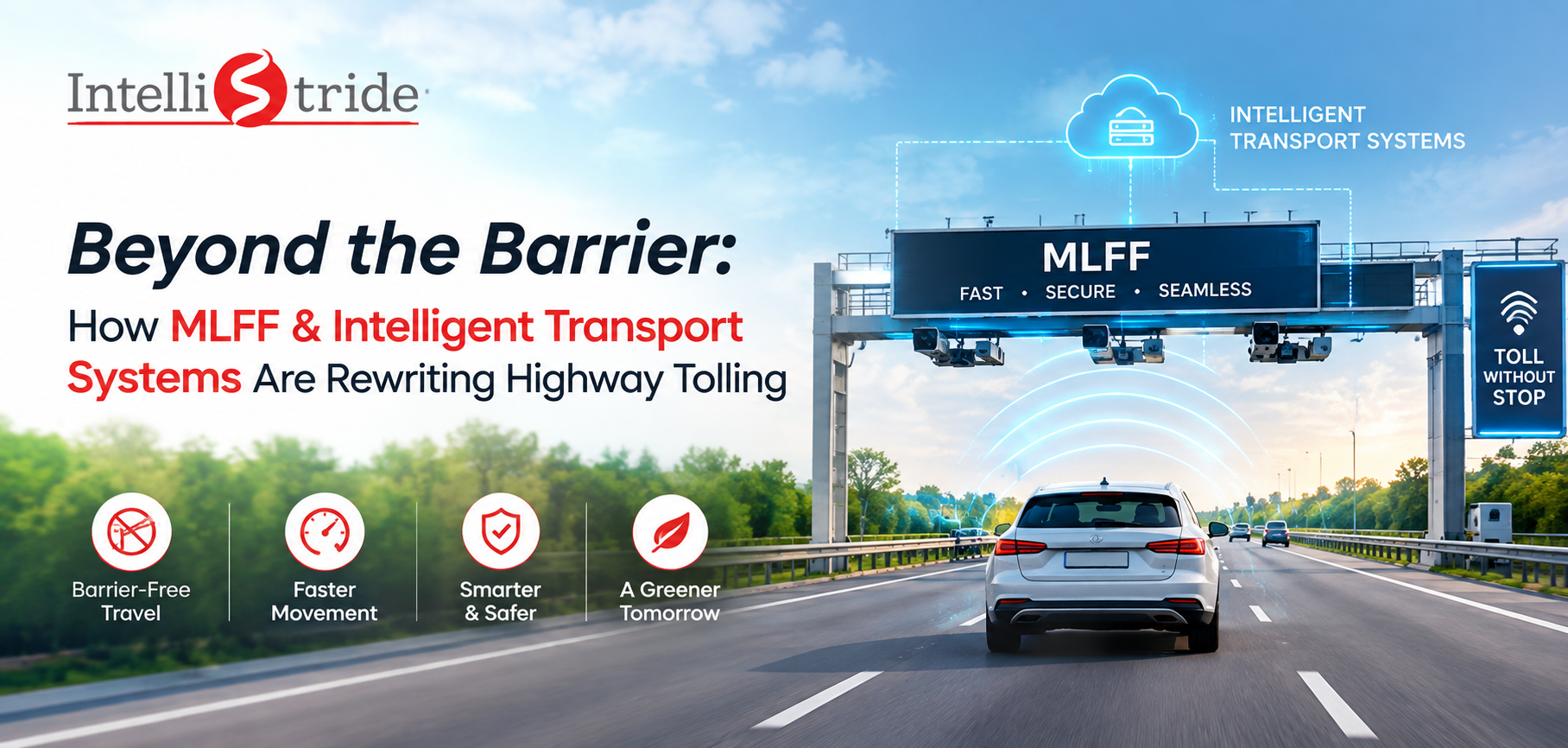
Beyond the Barrier: How MLFF & Intelligent Transport Systems Are Rewriting Highway Tolling
15 September 2026The Cost of the Queue
Picture this: a freight truck carrying time-sensitive cargo approaches a toll plaza during peak hour. The FASTag lane is backed up, the cash lane is worse, and the driver crawls through at 10 km/h behind a dozen other vehicles. Multiply that truck by the thousands crossing that plaza every day, and the “few minutes” becomes idling fuel burn, missed delivery windows, and a queue that never fully clears.
What follows isn’t just driver frustration. It’s a bottleneck baked into infrastructure that was designed for a slower, smaller traffic era — booth staffing costs, civil maintenance, and a cash-handling layer that’s always vulnerable to leakage. The real cost was never just the wait. It was every system downstream of that plaza absorbing the delay.
A barrier tells a vehicle to stop and prove it paid. A free-flow highway needs to know it’s paid — without ever asking the vehicle to slow down.
Why Barrier Tolling Can’t Keep Up Anymore
Boom gates and cash lanes served highways well for decades. But in a world of 100+ km/h commuter corridors, national freight volumes, and rising expectations for seamless mobility, the physical barrier has become the one component that can’t scale.
No Speed Loss Required
Multi-Lane Free Flow reads every vehicle in motion — no braking, no stopping, no single-file merge into a booth lane.
Continuous, Not Checkpoint-Based
Instead of one stop-and-verify moment, MLFF builds a live identification pass across every lane, at highway speed, every time.
Built for Highway Volume
Thousands of vehicles an hour, automatically classified and billed — no queue length limits how fast the system works.
Senses the Vehicle, Not Just the Tag
Radar and LiDAR classify height, length, and axle count in real time, so toll class is verified independently of the tag alone.
Beyond Tolling: A Unified ITS Ecosystem
IntelliStride doesn’t stop at reading a tag under a gantry. We build the connective layer between hardware, data, and the tolling systems your teams already run — turning scattered checkpoints into one living view of the corridor.
The IoT Platform
A dedicated software layer that fuses ANPR, RFID, and radar/LiDAR data and connects it directly to your Tolling Management System — no rip-and-replace required.
Barrier-Free Highway Tolling
Full Multi-Lane Free Flow at 80–120 km/h, built on Kathrein’s ISO 18000-63 RFID hardware under our exclusive APAC partnership.
Barriered Electronic Toll Collection & Smart Parking
For corridors and facilities not yet ready for full MLFF, the same RFID backbone runs barriered ETC and smart parking infrastructure.
Smart City & Enforcement Use Cases
ANPR-driven congestion charging, automated law enforcement, emergency vehicle preemption, and railway wagon tracking — one hardware investment, multiple use cases.
Revenue Transparency Isn’t Optional — It’s Competitive Advantage
As highway authorities move from cash-based collection to fully digital tolling, the operators pulling ahead are the ones treating transparent, auditable revenue as infrastructure, not an afterthought.
Every vehicle pass is cross-verified across ANPR, RFID, and radar/LiDAR, which makes mismatched billing or toll evasion far harder to slip through undetected. And because reliability depends on hardware as much as software, precision-engineered readers and antennas keep reads accurate at highway speed, in monsoon rain, and in dense multi-lane traffic.
Every Highway Corridor Has Unique Needs
Whether it’s a national expressway moving to full MLFF or a city rolling out congestion charging, the right path is a phased deployment backed by hardware expertise — not a one-size-fits-all gantry.
Ask IntelliStride About ITS & MLFF
Tap a question below to see how we answer it — or reach out and our team will follow up directly.
What’s the difference between MLFF and FASTag?
FASTag is an RFID tag read at a barrier-based toll booth, where vehicles still slow down to pass through. MLFF removes the barrier entirely, fusing RFID with ANPR cameras and radar/LiDAR so vehicles never drop below highway speed.
- FASTag alone still requires a boom-gate stop
- MLFF verifies the vehicle through multiple sensors at full speed
- Both can run on the same underlying RFID hardware standard
How does MLFF prevent toll evasion without a physical barrier?
Through sensor fusion. ANPR cameras and RFID readers cross-verify each other, while 4D radar and 3D LiDAR confirm vehicle classification — so any mismatch between a vehicle and its billing record is automatically flagged for enforcement.
What’s the difference between ITS and MLFF?
Intelligent Transport Systems (ITS) is the broader ecosystem — sensors, AI, IoT, and real-time communication across roads, vehicles, and control centers. MLFF is one specific ITS application, focused on barrier-free highway tolling.
How does the IoT Platform integrate with existing Tolling Management Systems?
The IoT Platform sits between the gantry hardware — ANPR cameras, RFID readers, radar/LiDAR — and your existing Tolling Management System, pushing verified transaction data via APIs so both systems share a single source of truth, with minimal disruption to what’s already running.
What is GNSS-based tolling, and is it replacing MLFF?
GNSS (satellite) tolling charges vehicles based on actual distance driven, tracked by satellite positioning rather than a physical gantry. It’s considered the next evolution after MLFF, but the two are expected to coexist for years, especially on high-traffic corridors where gantry-based MLFF is already proven.
How does ITS support smart city and enforcement use cases beyond tolling?
The same ANPR and sensor infrastructure used for tolling can cross-reference plates against stolen-vehicle and insurance databases, support urban congestion charging, and trigger emergency vehicle preemption at traffic signals — one hardware layer, multiple applications.
How should a business start evaluating an MLFF or ITS deployment?
It starts with the hardware and standards layer — RFID reader and antenna quality, ANPR accuracy in adverse conditions, and compatibility with the existing Tolling Management System — before any software or app-layer decisions are made.
Ready to talk MLFF or ITS infrastructure?
Find out how IntelliStride’s RFID and IoT solutions fit your corridor or facility.
Get In Touch- Intellistride.com
- Blog
- Beyond the Barrier: How MLFF & Intelligent Transport Systems Are…