
Blog on RFID Technology and IoT Solutions
Blog Home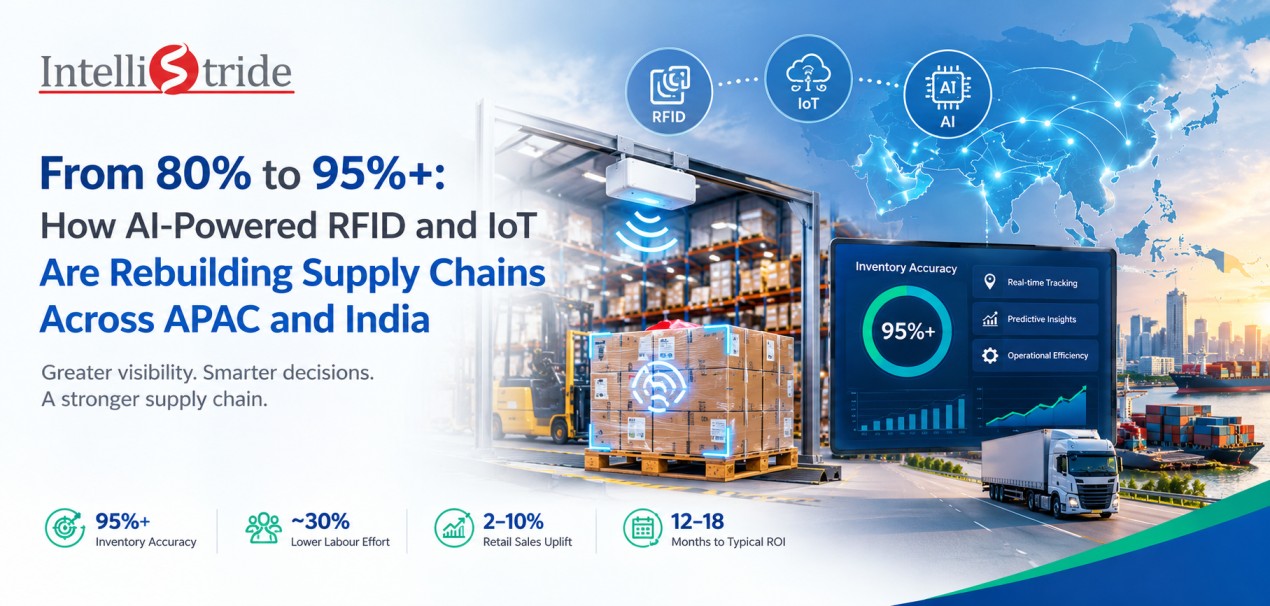
From 80% to 95%+: How AI-Powered RFID and IoT Are Rebuilding Supply Chains Across APAC and India
23 October 2026It’s 11:40 PM in peak season. The system says 480 cartons. The shelf has 390.
Every supply chain leader in India and Asia-Pacific knows this moment. Orders are stacking up, the number on the screen is wrong, someone is sent to count by hand, and a customer is promised stock that does not exist.
This is not a people problem. It is a visibility problem. Barcode-driven warehouses typically run at 60–80% inventory accuracy, and the missing 20–40% quietly feeds stockouts, excess safety stock, scanning bottlenecks and lost loyalty.
The fix is RFID + IoT + AI working as one system. It takes accuracy to 95%+, removes line-of-sight limits and turns tracking into prediction.
- 95%+ inventory accuracy
- ~30% lower labour effort
- 2–10% retail sales uplift
- 12–18 months to typical ROI
The 4-step supply chain intelligence stack
Isolated hardware upgrades rarely move the needle. A layered stack does.
Step 1 · The Eyes. RFID and IoT sensors read tags without line-of-sight. Fixed readers count whole pallets in one pass; sensors add temperature, humidity, vibration and shock.
Step 2 · The Brain. AI filters duplicate and ghost reads from millions of daily pings, flags anomalies in seconds and learns theft and shrinkage patterns.
Step 3 · The Forecast. Predicts shortages days ahead, reroutes around transit delays and schedules equipment maintenance before breakdowns.
Step 4 · Self-Optimization. Replenishment triggers before stockouts, slotting adapts for faster picking, and carriers are chosen on live performance.
RFID alone gives a firehose of uninterpreted data. AI alone has no physical signal to learn from. Together they form a self-improving operational engine.
What’s trending now, and how IntelliStride answers it
Five shifts are reshaping supply chains in 2026. Each one is a reason to act, and each maps to something we already deliver.
Trend 1 · Physical AI
AI needs physical signals
2026 is being called the year Physical AI, real-time item location and agentic AI converge.
Our answer: RFID and IoT supply the live signal; our AI layer filters noise, flags anomalies and drives predictive decisions.
Trend 2 · Upstream RFID
Tag at the source
Retailers now expect suppliers to tag at the factory and distribution centre, not just in store.
Our answer: end-to-end deployments from production line to dock door to shelf, on one platform.
Trend 3 · Digital Product Passports
Compliance becomes a data problem
EU rules need a digital record reachable by QR or RFID. First standards landed in May 2026; the battery passport applies from 18 Feb 2027, for goods made anywhere.
Our answer: item-level identification and lifecycle data capture that keep Indian and APAC exporters EU-ready.
Trend 4 · Ambient IoT
Condition data at item level
Battery-free, sensor-rich devices are emerging alongside RFID.
Our answer: an IoT Platform built to ingest tags and sensors together, so new device types plug in without a rebuild.
Trend 5 · India’s digital rails
Scale is arriving
FASTag made RFID familiar, and Indian Railways is rolling out RFID on engines, coaches and wagons using GS1 standards.
Our answer: proven large-scale infrastructure experience, including the Mumbai Trans Harbour Link deployment.
Market signal: industry research puts the global RFID market at roughly US$19 billion in 2026, and retailers deploying RFID fully report ROI above 10%.
Use cases across the supply chain
Warehousing
Dock-door verification
- Problem: manual scans miss items and slow inbound and outbound.
- Solution: fixed readers count whole pallets automatically as they pass.
- Outcome: fewer sorting errors, roughly 30% lower labour effort.
Retail & distribution
Always-on shelf availability
- Problem: inaccurate stock leads to out-of-stocks and lost sales.
- Solution: item-level RFID with AI-triggered replenishment.
- Outcome: 95%+ accuracy and a 2–10% sales uplift.
Pharma & cold chain
Chain of custody
- Problem: temperature excursions and counterfeits put compliance at risk.
- Solution: IoT sensors with RFID track custody and condition in transit.
- Outcome: automated alerts before spoilage, verified authenticity.
Manufacturing
WIP and material tracking
- Problem: unclear work-in-progress stalls scheduling.
- Solution: tags on materials and WIP feed live production dashboards.
- Outcome: tighter scheduling and higher equipment utilisation.
Asset management
Returnable and high-value assets
- Problem: pallets, containers and equipment go missing or sit idle.
- Solution: continuous location and status tracking across sites.
- Outcome: better utilisation, less loss, audit-ready records.
Cross-border logistics
Transit visibility
- Problem: delays surface only after they hurt.
- Solution: GPS and RFID checkpoints with AI route recalculation.
- Outcome: disruptions anticipated and routes adjusted early.
Where it pays off, industry by industry
Industry | What drives value | What changes |
|---|---|---|
Logistics & warehousing | Labour efficiency | Multi-item reads end manual sorting errors and speed up dock-door checks |
Retail & e-commerce | Availability, loss prevention | 2–10% sales uplift from fewer out-of-stocks, plus dual-layer loss prevention |
Healthcare & pharma | Compliance and safety | Chain-of-custody for critical drugs, sterilisation checks, counterfeit blocking |
Manufacturing | Uptime, asset utilisation | Raw material and WIP tracking, tighter scheduling, higher equipment use |
Cold chain | Quality control | Live temperature, humidity and shock alerts that prevent spoilage |
How IntelliStride is different
Our core strength
Asset management expertise
We think in assets, not just tags. Knowing what you own, where it is, what condition it is in and how well it is used is the foundation of every supply chain decision, and it is where our experience runs deepest.
Our commitment
We stay beyond proof
Proving results in a pilot is where our work begins, not where it ends. We stay with you as you scale to more zones, sites and countries, tuning the system, supporting your teams and keeping the numbers improving.
One accountable partner
Tagging, readers, edge, cloud analytics and ERP/WMS integration from a single team, not a patchwork of vendors.
Exclusive Kathrein hardware
Our exclusive APAC partnership brings enterprise-grade, industrial-ready readers and antennas.
Intelligence, not just tracking
Our IoT Platform turns raw reads into alerts, dashboards, live maps and audit reports.
Proven at scale
From the Mumbai Trans Harbour Link deployment to the CEMAT SEA 2024 award, built in demanding environments.
Local depth, regional reach
A presence across 16+ APAC markets, from dense Indian corridors to cross-border trade lanes.
Integrate, don’t replace
Standard REST APIs connect to your existing ERP and WMS. No rip-and-replace.
The business case, without the hand-waving
- Pilot first. Prove it in one warehouse zone or product category.
- Scale on evidence. Expand once accuracy and labour numbers are visible, with us alongside you well after the pilot is proven.
- Measure honestly. Over a 3–5 year TCO view, with roughly 30% lower labour effort, reduced shrinkage and avoided stockouts, full ROI is typically reached in 12–18 months.
- Secure by design. End-to-end encryption, role-based access and network segmentation.
FAQs from teams across India and APAC
How accurate is RFID compared to barcodes?
Barcode warehouses usually reach 60–80% inventory accuracy. AI-powered RFID typically lifts this to 95%+ by reading in bulk without line-of-sight while AI filters noise.
Will RFID work on metal, liquids and in hot, dusty conditions?
Yes, with the right tag and reader selection. On-metal and industrial-grade tags and ruggedised readers are built for harsh environments, and a site survey and pilot confirm performance before rollout.
Is it too expensive for my business?
Passive tags are low-cost and a pilot limits upfront spend. Most clients assess ROI over 3–5 years, with payback typically in 12–18 months.
Do I need to replace my ERP or WMS?
No. Standard APIs and middleware connect RFID and IoT data to your existing systems.
How long does a pilot take, and what should I measure?
Pick one high-impact zone and track inventory accuracy, cycle-count time, labour hours and stockout rate before and after.
Is RFID needed for EU export compliance?
The EU Digital Product Passport accepts QR codes or RFID as the data carrier. RFID suits item-level identification at volume with automatic reads across factory and logistics.
How is the IoT platform different from RFID alone?
RFID identifies. IoT sensors add condition data such as temperature and shock. The AI layer interprets both and triggers action.
Can it protect pharma and cold chain products?
Yes. Continuous temperature and humidity monitoring, chain-of-custody tracking and anti-counterfeit verification support compliance and cut spoilage.
How secure is the data?
End-to-end encryption, role-based access control and network segmentation protect sensitive operational data.
Does IntelliStride support multi-country operations?
Yes. With a presence across 16+ APAC markets, we support cross-border rollouts with consistent standards and local expertise.
Ready to move from 80% to 95%+?
RFID gives you the eyes, IoT adds the senses, and AI supplies the judgement. Start with a focused pilot in one warehouse zone and see the numbers for yourself.
- Intellistride.com
- Blog
- From 80% to 95%+: How AI-Powered RFID and IoT Are…