
Blog on RFID Technology and IoT Solutions
Blog Home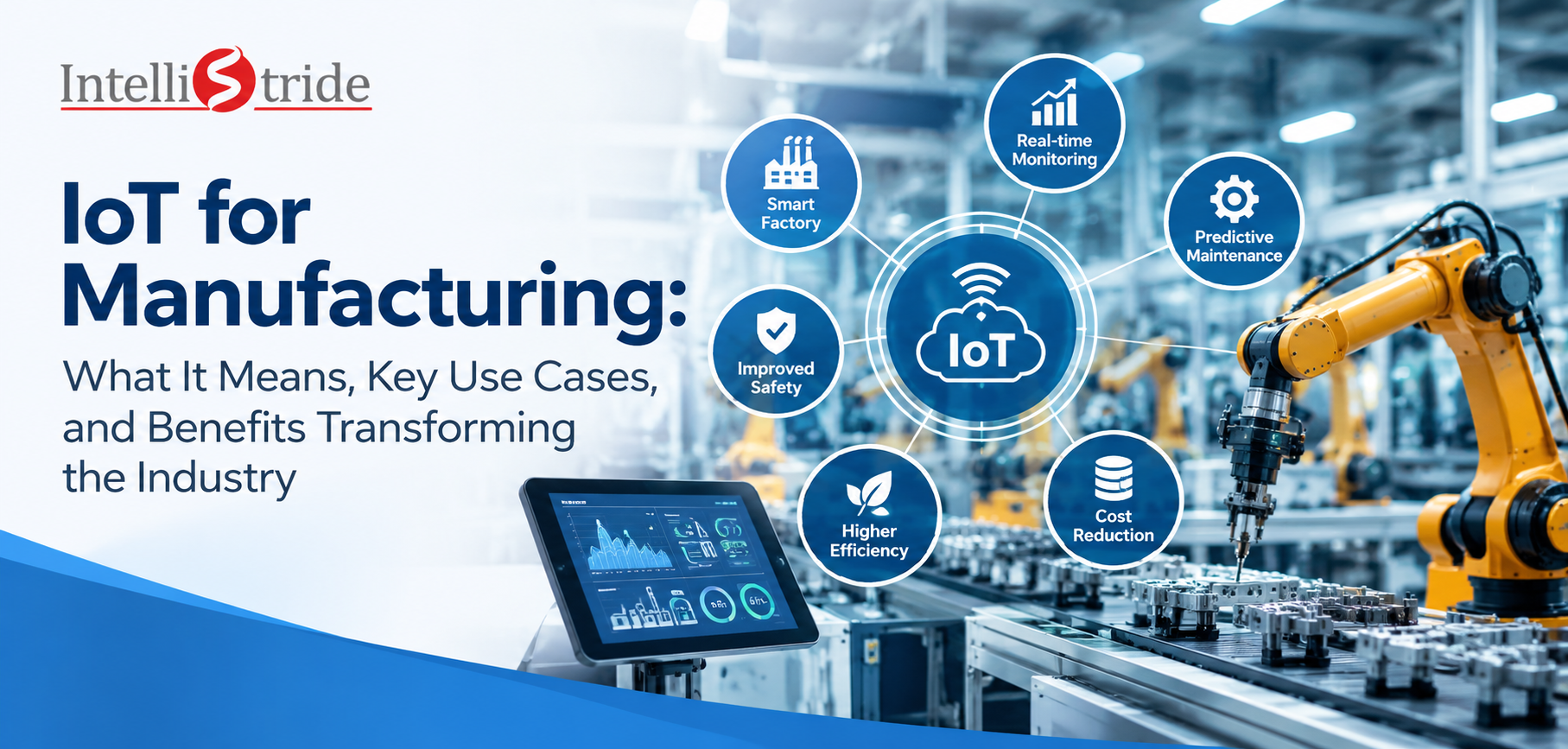
IoT for Manufacturing: What It Means, Key Use Cases, and Benefits Transforming the Industry
07 September 2026Introduction: The Rise of IoT in Manufacturing
The manufacturing sector is undergoing its most significant transformation since the advent of the assembly line — and the driving force behind this shift is the Internet of Things (IoT). From smart sensors on production lines to AI-powered predictive maintenance systems, IoT for manufacturing is redefining how factories operate, how machines communicate, and how decisions are made on the shop floor.
According to industry estimates, the global Industrial IoT (IIoT) market is projected to surpass $1 trillion by 2030, growing at a CAGR of over 20%. Manufacturers across automotive, electronics, pharmaceuticals, and heavy industries are adopting connected technologies not as a luxury, but as a competitive necessity.
This guide breaks down what IoT means for manufacturing, explores its most impactful use cases, examines measurable benefits, and answers the most common questions manufacturers ask before starting their IoT journey.
What Does IoT Mean in Manufacturing?
IoT in manufacturing, often called Industrial IoT (IIoT), refers to a network of interconnected sensors, devices, machines, and software systems that collect, exchange, and analyze data across the production environment in real time.
Unlike traditional manufacturing setups where machines operate in isolated silos, an IoT-enabled factory connects every asset — from raw material inventory to finished goods on the loading dock — into a single, intelligent ecosystem. This connectivity is powered by technologies such as:
- RFID (Radio Frequency Identification) tags for asset and inventory tracking
- RTLS (Real-Time Location Systems) for tracking people, tools, and equipment
- Industrial sensors measuring temperature, vibration, pressure, and humidity
- Edge computing devices that process data closer to the source
- Cloud-based IoT platforms that aggregate data for analytics and dashboards
- AI and machine learning models that convert raw data into predictive insights
Together, these components form what is commonly referred to as Industry 4.0 — the fourth industrial revolution, characterized by automation, data exchange, and smart decision-making.
How IoT Is Transforming the Manufacturing Industry
1. From Reactive to Predictive Operations
Traditionally, manufacturers relied on scheduled maintenance and manual inspections. IoT flips this model by enabling predictive and prescriptive operations — machines and systems now signal issues before they cause downtime.
2. End-to-End Visibility
IoT connects previously disconnected stages of production — procurement, inventory, shop floor, quality control, and logistics — into a unified data stream. This gives plant managers real-time visibility across the entire value chain.
3. Data-Driven Decision Making
With sensors continuously feeding data into centralized dashboards, decision-makers no longer rely on gut feeling or delayed reports. IoT platforms provide live KPIs, alerts, and analytics that drive faster, more accurate decisions.
4. Human-Machine Collaboration
IoT doesn’t replace the workforce — it augments it. Wearables, smart PPE, and RTLS-enabled safety systems help human workers operate more safely and efficiently alongside automated systems.
5. Sustainability and Energy Optimization
Smart sensors monitor energy consumption, emissions, and resource usage, helping manufacturers meet ESG goals while reducing operational costs.
Top Use Cases of IoT in Manufacturing
1. Predictive Maintenance
IoT sensors monitor equipment health indicators like vibration, temperature, and sound in real time. Machine learning algorithms analyze this data to predict failures before they occur, allowing maintenance teams to act proactively rather than reactively. This reduces unplanned downtime by up to 50% and extends equipment lifespan significantly.
2. Real-Time Asset Tracking (RFID & RTLS)
Manufacturers use RFID tags and RTLS technology to track raw materials, work-in-progress (WIP) inventory, tools, and finished goods across the facility. This eliminates manual inventory counts, reduces lost or misplaced assets, and improves overall supply chain accuracy.
3. Smart Quality Control
IoT-enabled vision systems and sensors detect defects in real time during production, rather than after the fact. This reduces scrap rates, rework costs, and ensures consistent product quality.
4. Digital Twins
A digital twin is a virtual replica of a physical asset, production line, or entire factory. IoT data feeds these digital models, allowing manufacturers to simulate changes, test scenarios, and optimize processes without disrupting live operations.
5. Supply Chain and Inventory Optimization
Connected sensors and RFID-based tracking give manufacturers real-time insight into inventory levels, shipment status, and supplier performance — enabling just-in-time manufacturing and reducing carrying costs.
6. Worker Safety and Compliance
Wearable IoT devices and RTLS-based geofencing alert workers and supervisors of hazardous zones, equipment proximity, or safety violations, significantly reducing workplace accidents.
7. Energy and Resource Monitoring
IoT sensors track electricity, water, and gas consumption across production lines, identifying inefficiencies and helping manufacturers cut energy costs by 10–20%.
8. Automated Production Line Monitoring
Connected PLCs (Programmable Logic Controllers) and sensors provide continuous visibility into machine performance, output rates, and Overall Equipment Effectiveness (OEE).
Key Benefits of IoT for Manufacturing
Benefit | Impact |
|---|---|
Reduced Downtime | Predictive maintenance minimizes unplanned equipment failures |
Higher Productivity | Real-time monitoring identifies bottlenecks instantly |
Improved Quality | Automated defect detection reduces waste and rework |
Cost Savings | Optimized energy use, inventory, and maintenance schedules |
Better Safety | Real-time hazard alerts and worker location tracking |
Supply Chain Accuracy | RFID/RTLS eliminate manual tracking errors |
Data-Driven Growth | Actionable insights support long-term strategic planning |
Regulatory Compliance | Automated audit trails and traceability for regulated industries |
Manufacturers that adopt IoT-driven operations typically report 20–30% improvements in operational efficiency and a measurable reduction in total cost of ownership (TCO) within the first 12–18 months of deployment.
Challenges Manufacturers Should Plan For
While the benefits are substantial, successful IoT adoption requires addressing a few common challenges:
- Integration with legacy systems — older machinery may require retrofitting with sensors or gateways
- Data security — connected devices expand the attack surface, requiring robust cybersecurity protocols
- Scalability — solutions should be built to scale from a single production line to an entire multi-site operation
- Change management — workforce training and process alignment are critical to adoption success
Partnering with an experienced IoT and RFID solutions provider — one with proven hardware integration, a robust IoT platform, and cross-industry deployment experience — helps manufacturers navigate these challenges with a phased, low-risk roadmap rather than a disruptive overhaul.
The Future of IoT in Manufacturing
As 5G connectivity, edge AI, and advanced RFID/RTLS technologies mature, IoT in manufacturing will move beyond monitoring toward fully autonomous, self-optimizing production environments. Expect deeper integration of AI-driven analytics, digital twins, and cross-facility IoT networks that allow global manufacturers to manage operations from a single, unified platform — regardless of geography.
Manufacturers who invest in scalable IoT infrastructure today are positioning themselves to lead in an increasingly connected, data-driven industrial landscape.
Frequently Asked Questions (FAQs)
1. What is IoT in manufacturing?
IoT in manufacturing (also called Industrial IoT or IIoT) is the use of connected sensors, devices, and software to collect and analyze real-time data across production processes, enabling smarter, more efficient, and predictive operations.
2. What is the difference between IoT and IIoT?
IoT broadly refers to any connected device (including consumer devices like smart thermostats), while IIoT (Industrial IoT) specifically refers to IoT applications within industrial settings such as manufacturing, energy, and logistics, with a focus on reliability, safety, and scalability.
3. How does IoT reduce manufacturing downtime?
IoT sensors continuously monitor machine health indicators such as vibration, temperature, and pressure. Predictive algorithms analyze this data to flag potential failures before they happen, allowing maintenance teams to intervene proactively rather than after a breakdown occurs.
4. Is IoT adoption expensive for small and mid-sized manufacturers?
While there is an upfront investment, most manufacturers see ROI within 12–18 months through reduced downtime, lower energy costs, and improved productivity. Many providers also offer phased, modular deployment models to reduce initial costs.
5. What role does RFID play in IoT for manufacturing?
RFID (Radio Frequency Identification) is a foundational IoT technology used for real-time asset tracking, inventory management, and supply chain visibility — enabling manufacturers to track materials and products without manual scanning.
6. How secure is IoT data in manufacturing environments?
Security depends on the platform and implementation. Best practices include encrypted data transmission, network segmentation, regular firmware updates, and choosing IoT platforms with built-in cybersecurity protocols.
7. Can IoT be integrated with existing legacy machinery?
Yes. Retrofitting legacy equipment with IoT sensors and edge gateways allows older machines to be integrated into a modern IoT ecosystem without requiring a full equipment replacement.
8. What industries benefit most from IoT in manufacturing?
Automotive, electronics, pharmaceuticals, semiconductors, heavy machinery, and food & beverage manufacturing are among the sectors seeing the highest ROI from IoT adoption, particularly through predictive maintenance and asset tracking.
9. What is a digital twin, and how does it relate to IoT?
A digital twin is a virtual, real-time representation of a physical asset or process, powered by continuous IoT data. It allows manufacturers to simulate and optimize operations without impacting live production.
10. How do I start implementing IoT in my manufacturing facility?
Start with a pilot project in a high-impact area — such as predictive maintenance on critical equipment or RFID-based inventory tracking — before scaling across the facility. Partnering with an experienced IoT/RTLS solutions provider ensures a structured, low-risk rollout aligned with your operational goals.
Looking to bring IoT-driven visibility, predictive maintenance, and real-time asset tracking to your manufacturing facility? Explore how purpose-built RFID, RTLS, and IoT platforms can accelerate your Industry 4.0 transformation
- Intellistride.com
- Blog
- IoT for Manufacturing: What It Means, Key Use Cases, and…