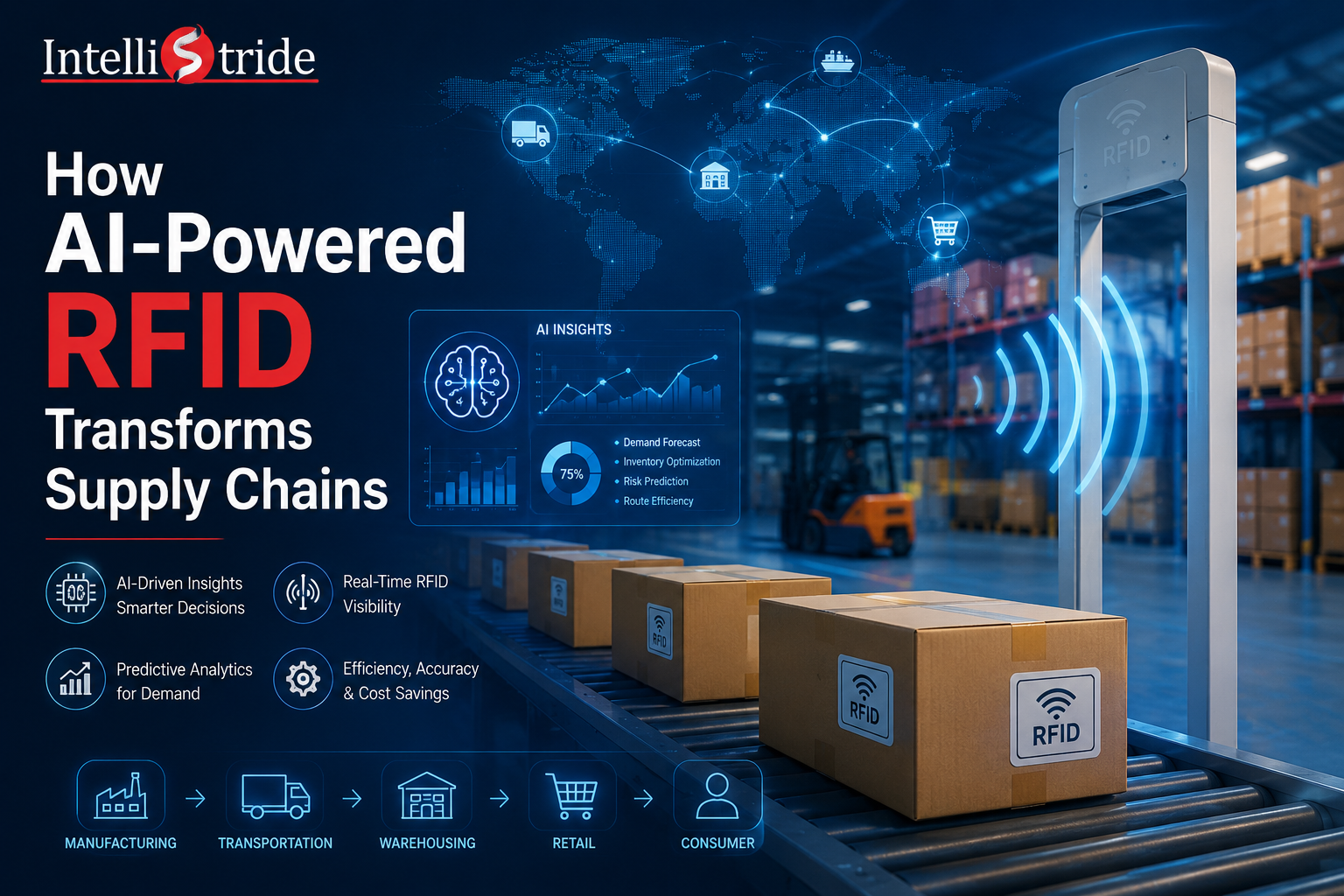
4 Use Cases, Proven ROI, and How to Build the Business Case
Most warehouses running on traditional barcodes achieve only 60–80% inventory accuracy. That missing 20–40% translates directly into stockouts, overstocking, and lost customers. AI-powered RFID closes that gap permanently — and builds a supply chain that anticipates problems before they surface.
- 60–80% Inventory accuracy with barcode systems
- 95%+ Accuracy achieved with AI-powered RFID
- 2–10% Sales uplift in retail post RFID/AI deployment
- ~30% Reduction in labour costs from automation
For decades, supply chain managers accepted inaccuracy as a cost of doing business. AI-powered RFID makes that trade-off obsolete combining real-time physical visibility with machine intelligence to create supply chains that see everything, predict what’s next, and act before problems escalate.
How AI and RFID Work Together: A 4-Step Supply Chain Intelligence Stack
AI-powered RFID is not a single technology — it is a layered system where each component multiplies the value of the last.
The Eyes
Step 1: RFID — Real-Time Inventory Visibility at Scale
RFID uses electromagnetic fields to automatically identify and track tagged assets — no manual scanning, no line of sight needed.
- Mass scanning: hundreds of items identified simultaneously, through pallets or packaging
- Auto-tracking: readers at dock doors and conveyor belts update locations instantly
- Labour reduction: automated counts eliminate manual error at every stage
The Brain
Step 2: AI — Converting Raw RFID Data into Actionable Insights
A single warehouse generates millions of RFID data points per day. Without AI, that is expensive noise. With it, every signal becomes a decision.
- Noise filtering: ML discards ghost reads and duplicate pings automatically
- Anomaly detection: discrepancies flagged within seconds of occurring
- Behavioural learning: detects theft, fraud, or breakdowns before they escalate
The Forecast
Step 3: Predictive Supply Chain Operations — From Reactive to Proactive
The most powerful shift is not reporting on the present — it is predicting the future. AI-RFID answers the question every supply chain asks: What will happen next?
- Demand forecasting: detect shortages days before manual systems flag anything
- Predictive logistics: anticipate delivery delays and reroute proactively
- Predictive maintenance: schedule machine downtime on your terms, not the machine’s
Autonomous
Step 4: The Self-Optimising, Autonomous Warehouse
Real-time visibility plus predictive intelligence enables a supply chain that doesn’t wait for humans to act on data — it acts itself.
- Automated replenishment: reorders triggered before stockouts occur
- Intelligent slotting: AI continuously reorganises storage for optimal pick efficiency
- Dynamic routing: carrier selection adjusts in real time based on live performance data
Why neither technology works alone
RFID without AI is a fire hose of uninterpreted data. AI without RFID is intelligence starved of real-world signal. Together, they close the loop that neither can close alone — turning physical asset movement into a continuous, self-improving decision engine. RFID gives you the eyes to see every physical asset. AI gives you the brain to turn those sights into decisions. Together, they give you the edge.
The strategic outcome
Proven ROI: What AI-Powered RFID Actually Delivers
These are not projections. Businesses deploying AI-RFID consistently report results that redefine their competitive position across inventory accuracy, labour costs, and revenue.
Measured outcomes across deployments
- 95%+Inventory accuracy vs 60–80% baseline
- ~30%Labour cost reduction through automation
- 2–10%Sales uplift from improved availability
Which Industries Benefit Most from AI RFID Technology?
AI-RFID delivers returns across sectors, but four industries see the fastest payback and the highest structural impact.
Retail
Sales uplifts of 2–10% from improved product availability, plus dual-layer loss prevention cutting shrinkage significantly across high-SKU environments.
Primary driver: availability + shrinkageLogistics & Warehousing
Multi-item simultaneous scanning slashes labour hours. Automated inbound and outbound verification eliminates manual error throughout the fulfilment chain.
Primary driver: labour efficiencyHealthcare Supply Chain
Critical asset availability ensures care continuity. Pharmaceutical traceability blocks counterfeit products from entering supply chains — a compliance and safety imperative.
Primary driver: compliance + safetyManufacturing
Predictive maintenance reduces unplanned downtime. AI surfaces underutilised machinery to maximise return on existing capital without new procurement spend.
Primary driver: uptime + asset utilisationOvercoming the barrier
How to Build the Business Case for AI-RFID — and De-Risk the Investment
Upfront cost is the most common objection. Here is how forward-thinking operations teams address it with structural discipline, not hope.
Pilot first, then scale
Start with a single warehouse zone or product category. Controlled pilots prove ROI, reduce risk, and build internal buy-in before full deployment.
Choose scalable architecture from day one
Modern AI-RFID platforms are built to grow. Start at a scale matched to current budget and expand as operational savings accumulate.
Integrate — don’t replace — existing systems
Leading RFID solutions connect to existing ERP and WMS platforms via standard APIs — no costly infrastructure overhauls or system migrations required.
Model total cost of ownership over 3–5 years
When labour savings, reduced shrinkage, prevented stockouts, and sales uplifts are factored in, ROI is typically compelling within 12–18 months of deployment.