
Blog on RFID Technology and IoT Solutions
Blog Home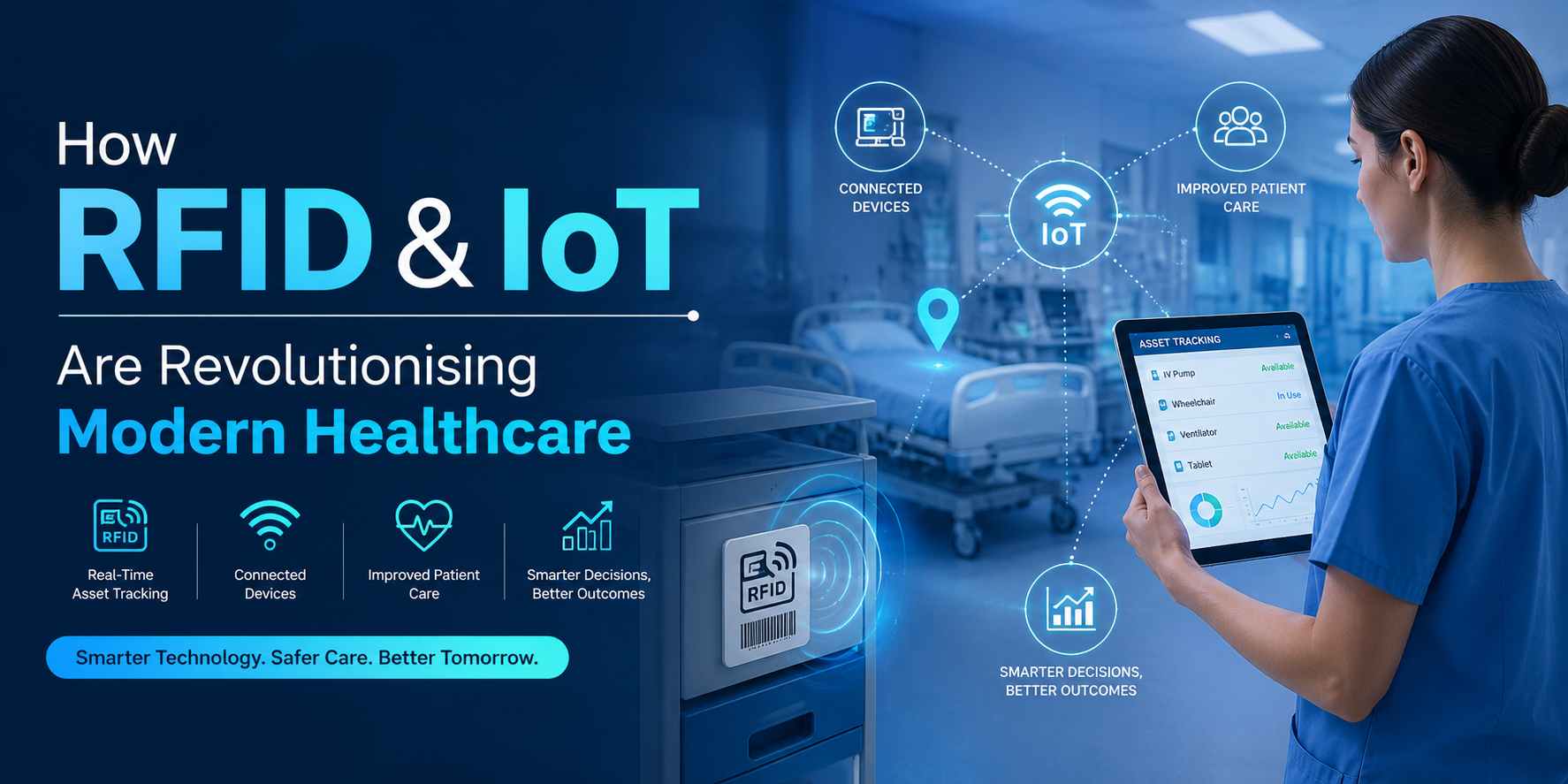
How RFID & IoT Are Revolutionising Modern Healthcare
23 June 2026Every critical care decision depends on three questions that should never need asking: Where is the patient? Where is the equipment? Who has access? RFID and IoT technology have made those questions obsolete — and in doing so, are quietly reinventing the modern hospital.
What Is RFID and IoT in Healthcare?
RFID (Radio Frequency Identification) uses radio waves to track people and assets without line-of-sight. Three components make it work: RFID tags embedded in wristbands, equipment labels, or medication packaging; antennas and readers that capture tag data instantly; and backend software that surfaces real-time information for clinical decisions.
IoT (Internet of Things) is the intelligence layer — an interconnected network of sensors, monitors, and medical devices communicating in real time. Where RFID identifies, IoT connects. Together they give hospitals a live, end-to-end view of everything that matters. That combination is why the global RFID healthcare market is projected to reach $14.6 billion by 2030.
4 RFID and IoT Use Cases Delivering Measurable Hospital ROI
The impact of RFID and IoT in healthcare is not theoretical — it is proven and already operational in hospitals worldwide. Here are the four highest-value applications.
01 Patient Safety & Positive Identification
RFID wristbands enforce positive patient identification at every touchpoint — right patient, right treatment, every time. In emergencies, staff locate patients instantly with zero manual cross-checks, reducing identification errors that contribute to thousands of adverse events annually.
02 Hospital Asset Tracking & Inventory Management
Clinical staff lose up to 30 minutes per shift searching for misplaced equipment. RFID gives every asset — IV pumps, ventilators, surgical kits — a real-time digital identity, eliminating downtime, reducing over-purchasing, and improving equipment utilisation rates.
03 Medication Management & Drug Safety Alerts
Smart RFID systems track each medication from pharmacy to bedside. The moment a dosage mismatch or drug interaction is detected, an automated alert fires — before administration. This closed-loop approach prevents thousands of medication errors annually and strengthens HIPAA audit trails.
04 Clinical Authentication & Access Control
A single badge tap logs a clinician in under 1 second — versus 15–30 seconds for manual login. The same credential grants zone access, auto-locks when staff step away, and generates a full audit trail. It works with gloved or wet hands, removing friction at every point of care.
Every badge tap, every patient movement, every medication scan — in the smart hospital, nothing happens in the dark. RFID and IoT turn invisible workflows into a living, auditable map of care.
Smart Hospital Case Study: Real Results from a Major European Clinic
A leading Romanian private clinic recently deployed a WMS-RFID system — treating hospital rooms as warehouse locations with ceiling-mounted RFID antennas throughout the facility. Manual barcode scanning was eliminated entirely. The outcomes were immediate.
Measurable impact on patient care and clinical operations
These results demonstrate the real-world ROI of RFID hospital technology when implemented with the right architecture.
- Patient movement from admission to discharge logged automatically — zero manual entry required
- OR scheduling optimised by tracking precise patient entry and exit times, cutting idle theatre time
- Families receive real-time notifications the moment a loved one leaves surgery
- Clinical staff redirected admin time to direct patient care
RFID Healthcare Implementation: 4 Challenges and How to Solve Them
A complete picture of RFID and IoT in healthcare must address the real friction points. None are insurmountable — but all require planning.
Infrastructure Investment
Upfront costs for tags, readers, and software integration can challenge smaller facilities. Long-term ROI — recovered staff time, lower equipment replacement, fewer errors — consistently justifies the spend. Phased rollouts reduce initial outlay.
Patient Data Security & HIPAA Compliance
Patient data demands the highest protection. Deployments must enforce end-to-end encryption, role-based access controls, and full HIPAA compliance. Security must be architected in from day one — never retrofitted.
RF Signal Interference
Metal surfaces, fluid-filled items, and MRI equipment can disrupt RFID signals. Successful deployments require site surveys, strategic antenna placement, and validated tag types for specific clinical environments.
EHR System Integration
Seamless connection with Epic, Cerner, and other Electronic Health Records platforms is non-negotiable. Siloed data negates the investment. Cross-functional IT and clinical collaboration from the outset prevents costly rework.
The Future of Smart Hospitals: 4 RFID and IoT Trends for 2025–2030
The trajectory of RFID and IoT in healthcare points toward capabilities that will feel routine within a decade. These are the four developments to watch.
Miniaturised RFID Tags
Smaller, eco-friendly tags enabling wearables, implantables, and micro-scale asset tracking across every clinical environment.
AI-Powered Predictive Analytics
Machine learning layered onto RFID data streams to predict inventory shortfalls, flag patient deterioration, and surface operational bottlenecks before they occur.
Real-Time 3D Hospital Mapping
Interactive spatial maps enabling live navigation for staff and patients, with automated fall-detection for high-risk individuals.
Unified Security Credentials
A single RFID credential governing physical access, digital authentication, and controlled-substance dispensing across the entire facility.
The connected clinic is already being built
Hospitals worldwide are deploying RFID and IoT room by room. The question is how quickly yours gets there.
- Intellistride.com
- Blog
- How RFID & IoT Are Revolutionising Modern Healthcare